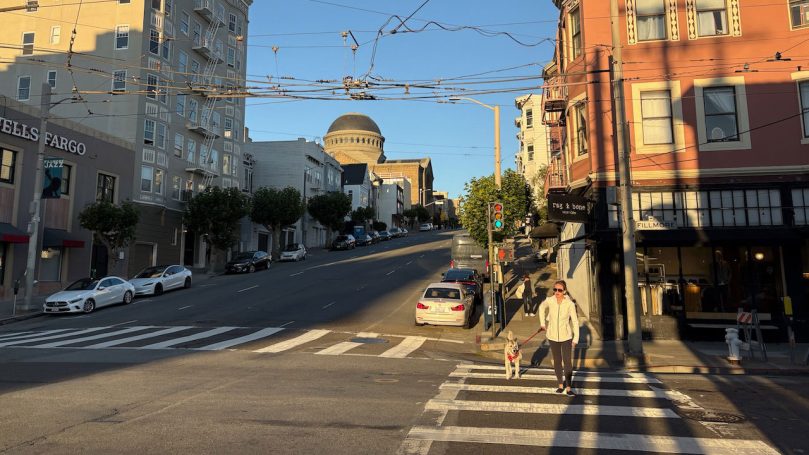
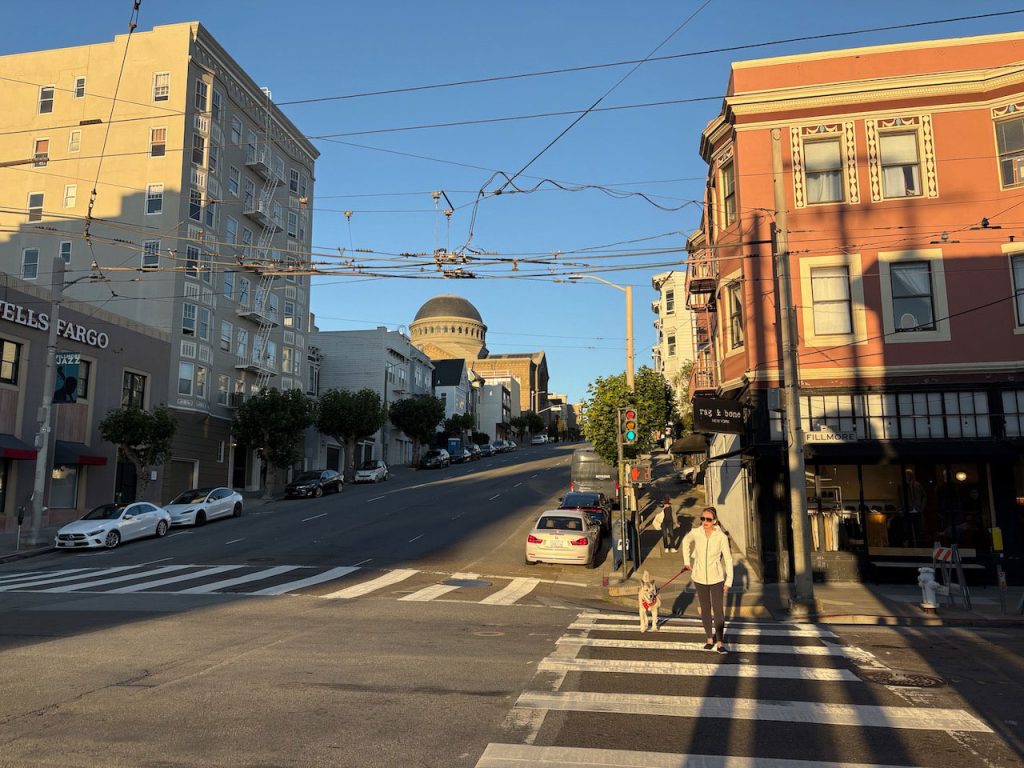
It’s a different story in Lower Pacific Heights
REAL ESTATE | CYNTHIA TRAINA
In Pacific Heights, 61 percent of home buyers paid cash over the past year. South of California Street, in Lower Pacific Heights, only 36 percent paid cash.
That gap is the story of this neighborhood. Two areas that share a border along California Street are playing very different real estate games.
The gap is revealed by a study of recorded sales for every house and condo that closed in Pacific Heights and Lower Pacific Heights between October 1, 2025, and September 30, 2026. Of 211 Pacific Heights buyers, 129 closed with no loan at all. Next door in Lower Pacific Heights, it was 27 of 75.
The easy explanation is that homes in Pacific Heights are more expensive, and expensive homes attract cash. At $10 million and up, 15 of 17 Pacific Heights buyers paid cash. But the pattern holds well below the trophy tier. Under $3 million, about half of Pacific Heights buyers — 66 of 124 — still paid cash. The bigger the purchase price in Pacific Heights, the more likely it was to close without a mortgage. The money driving this market largely isn’t borrowed, which also means it isn’t waiting on rate cuts.
Counting buyers actually understates the differential; counting dollars makes it unmistakable. Buyers spent $941 million on Pacific Heights homes during the last year, and $710 million of it was cash. That’s 75 cents of every dollar. In Lower Pacific Heights, $56 million of $148 million was cash, or 38 cents on the dollar.
The deed records also hint at who the buyers are. About one in six Pacific Heights buyers took title in an LLC or company name. In Lower Pacific Heights, it was only three of 75.
And there’s another tell: where the property tax bill goes. For 39 percent of Pacific Heights buyers, it’s mailed somewhere other than the home itself. In Lower Pacific Heights, that figure is 17 percent. That doesn’t necessarily mean they are second homes or investors. A bill can go to a business manager, a trust office or a family’s primary address. But it does paint a picture of buyers with layered finances, advisors and options — exactly the profile that pays cash.
The buyers are only half the picture. The people who stayed put tell you just as much. About four in 10 homes in both neighborhoods have no loan on them at all. These owners aren’t under the pressure of a monthly payment, so they sell when they wish, not when they must.
Many owners have been here a long time. At least 22 percent of Pacific Heights homes last sold 20 or more years ago, and at least 17 percent in Lower Pacific Heights. That kind of tenure builds a large gain, and a large tax bill with it, since the typical San Francisco home is reportedly worth about 66 percent more than it was 20 years ago. For many long-time owners, selling would mean a six-figure tax bill, so they stay, and some hold on so their heirs inherit the home at today’s value, which erases the gain.
The result is a thin market. About 1 in 20 Pacific Heights homes changed hands last year. In Lower Pacific Heights, it was about 1 in 30.
If you’re buying in Pacific Heights, assume you’re competing against cash, even under $3 million. A financed offer can still win, but it needs to look as close to cash as possible, with fully underwritten pre-approval, short or waived contingencies and a quick close. If you’re buying in Lower Pacific Heights, the field looks more like the rest of San Francisco, where about 38 percent paid cash. Financed buyers are the norm here, and a well-prepared loan offer competes on a more level playing field.
Cynthia Traina is a residential realtor with Vantage Realty. Contact her with news or suggestions at CT@CynthiaTraina.com or @PacificHeightsRealtor.