Minnie’s Can-Do Club

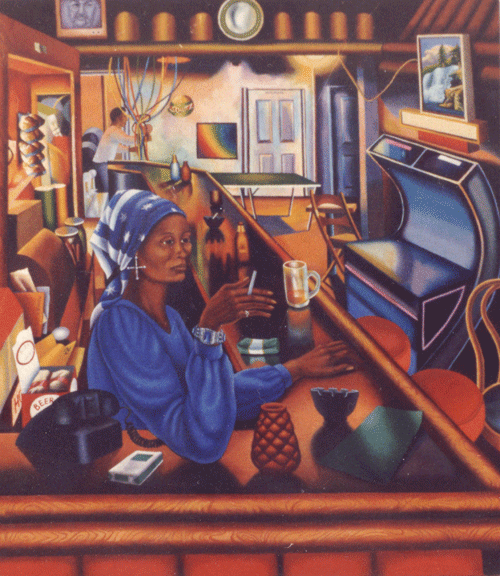
Portrait of Minnie Baker, 1973, by Nicola Lane

It was alive — very alive — for only five years at 1915 Fillmore Street, where Florio restaurant now stands. But Minnie’s Can-Do Club, the last of the old-time Fillmore joints, has become something of a legend.

The club itself is long gone. But Minnie Baker Thomas in 2007 is still among us. Until her recent move to Oakland, she lived at the Fillmore Center. At age 74 she’s still working, as she has for more than 20 years, as a merchant marine. She’s just back from China and four weeks at sea. And she says she plans to keep on shipping out. “Why not? — there’s no age limit,” she says.

She was back on Fillmore recently with friends from the glory days of the Can-Do Club, and they marveled at the force Minnie’s became almost from the day it opened.

“They all just came,” she says. “I was just sittin’ up there mindin’ my own business. My intent was just to sell beer.”

Minnie opened the club in 1969, and soon a group began to coalesce around her. Someone suggested music, so they got a piano. Someone else suggested poetry readings, and Tuesday became poetry night. They put a ping pong table in the back and had tournaments. One night the Chinese Olympic team stopped by to play.

“They busted me and said I needed an entertainment license,” Minnie recalls. “Somebody was always trying to shut me down. But too many people liked my place. And besides, what were we gonna do — dance ’em to death?”

The Redevelopment Agency had wiped out just about everything on Fillmore south of Bush Street, and the Summer of Love was over.

“There wasn’t too much going on back then,” Minnie recalls. “There was nothing to do on the other end of the street. And North Beach had died and was coming to Fillmore.”

“North Beach was, but Fillmore is,” wrote one of the poets.

And there was a party at the Can-Do Club every night. Minnie’s had “4,000 kinds of sanctified beer, and if you’re feeling athletic, they’ve got ping pong in the rear,” one singer sang.

“You know what? That place was something,” Minnie says. “Every day there was something. Every day there was a story.”

Back on Fillmore now, Minnie is warm and wise, her life an ongoing adventure. She laughs and tells stories about the Can-Do Club, but she does not pine for days gone by.

“I think of the good times,” she says. “And I know this is another time. The Can-Do was part of my highlights, but not all of it.”

Still, more than 30 years after it closed, the club is never far away. “There’s no way I can get away from it,” she says. “There’s always somebody somewhere. Even at sea, somebody comes up and says, ‘Didn’t you used to be on Fillmore?’ ”

Photograph of Minnie Baker in 2007 by Ed Brooks

Share
  • Barbara Wyeth

    When I moved to San Francisco in the early 70s, everyone I met wanted to turn me on to what was happening in my new city. One of my new friends said he needed to take me to the hippest place in town for live music. I was game. So one night we hopped on Muni and headed over to Fillmore Street, to Minnie’s Can-Do Club.

    That night we walked through the door into multi-ethic, multi-cultural, jumpin’ San Francisco. The place was smoky and crowded and sweaty and rockin’ — no brooding, angry, angst-ridden music going on here. The good times were rolling, the beer was flowing, and absolutely everybody in the place seemed to be moving to some very funky blues coming from a small stage at the back of the room. From that night on, Minnie’s became my club of choice.

    Minnie herself presided over the bar. She ran a tight ship, but was kind, maternal and good-looking, too. It seemed impossible that the fully adult male bartender was in fact her son. She believed in supporting local writers. Poets like ruth weis and devora major read there.

    And the music! Minnie’s was one of very few clubs that showcased local blues bands, keeping live music going at a time when deejays and disco were becoming the norm in many of the city’s clubs. It could be a pretty rowdy place, but Minnie never let it get out of hand. The stage was only a step above the dance floor and there was much flirting and carrying-on between the band members and the women in the crowd. The restrooms flanked the stage, men’s on the left side, women’s on the right. The women’s always had a line, and you had to walk right up to the band, and sometimes stand practically on stage to wait your turn. During the evening, the musicians managed to get a pretty good look at all of the women in the bar, and we had a chance to gossip and laugh and size up the band as we waited.

    Aside from all the socializing, the music was terrific: gritty, funky, homegrown Bay Area blues. Jazz was big in the city at that time — at Keystone Corner and the Matador in North Beach, especially — but a lot of musicians like my saxophone-playing friend liked to get loose and have fun playing rhythm and blues — dance music. And Minnie’s was all about dancing.

    The minute the juke box went on people were up and shaking booty. Then the band would start up and it would just keep on going. When the exhausted musicians finally called it quits, the juke box was on again — the Ohio Players, the Commodores, Sly and the Family Stone, Marvin Gaye, War, Aretha.

    One night I remember Minnie literally shoving a bunch of us out the door, delirious, more than a bit drunk, just plain unwilling to let the fun stop. “Hush up and go home now,” she said. “I got a license to worry about.” Out we went spilling onto the sidewalk. Directly across the street, the New Zion Baptist Church sat prim and scolding. A street light glowed softly in the fog as we dispersed into the cold summer San Francisco night.

    The fun did stop when Minnie had to move her club to the Haight. I went there a few times and saw the opening production of Notzge Shange’s “For Colored Girls Who Committed Suicide When the Rainbow Is Enough.” Minnie was again supporting artists, giving them a place to perform. But for me the place never regained the fun and funk of her Fillmore Street joint.

    Years later, I ate at the restaurant that Minnie’s had become at the time. I was most curious about the restroom. It was still in the same place, or so it seemed, but it no longer had the aluminum anti-rust paint on the walls or the machine that dispensed tropical-colored condoms. And there was no cute drummer to flirt with while I waited.

  • Barbara Wyeth

    When I moved to San Francisco in the early 70s, everyone I met wanted to turn me on to what was happening in my new city. One of my new friends said he needed to take me to the hippest place in town for live music. I was game. So one night we hopped on Muni and headed over to Fillmore Street, to Minnie’s Can-Do Club.

    That night we walked through the door into multi-ethic, multi-cultural, jumpin’ San Francisco. The place was smoky and crowded and sweaty and rockin’ — no brooding, angry, angst-ridden music going on here. The good times were rolling, the beer was flowing, and absolutely everybody in the place seemed to be moving to some very funky blues coming from a small stage at the back of the room. From that night on, Minnie’s became my club of choice.

    Minnie herself presided over the bar. She ran a tight ship, but was kind, maternal and good-looking, too. It seemed impossible that the fully adult male bartender was in fact her son. She believed in supporting local writers. Poets like ruth weis and devora major read there.

    And the music! Minnie’s was one of very few clubs that showcased local blues bands, keeping live music going at a time when deejays and disco were becoming the norm in many of the city’s clubs. It could be a pretty rowdy place, but Minnie never let it get out of hand. The stage was only a step above the dance floor and there was much flirting and carrying-on between the band members and the women in the crowd. The restrooms flanked the stage, men’s on the left side, women’s on the right. The women’s always had a line, and you had to walk right up to the band, and sometimes stand practically on stage to wait your turn. During the evening, the musicians managed to get a pretty good look at all of the women in the bar, and we had a chance to gossip and laugh and size up the band as we waited.

    Aside from all the socializing, the music was terrific: gritty, funky, homegrown Bay Area blues. Jazz was big in the city at that time — at Keystone Corner and the Matador in North Beach, especially — but a lot of musicians like my saxophone-playing friend liked to get loose and have fun playing rhythm and blues — dance music. And Minnie’s was all about dancing.

    The minute the juke box went on people were up and shaking booty. Then the band would start up and it would just keep on going. When the exhausted musicians finally called it quits, the juke box was on again — the Ohio Players, the Commodores, Sly and the Family Stone, Marvin Gaye, War, Aretha.

    One night I remember Minnie literally shoving a bunch of us out the door, delirious, more than a bit drunk, just plain unwilling to let the fun stop. “Hush up and go home now,” she said. “I got a license to worry about.” Out we went spilling onto the sidewalk. Directly across the street, the New Zion Baptist Church sat prim and scolding. A street light glowed softly in the fog as we dispersed into the cold summer San Francisco night.

    The fun did stop when Minnie had to move her club to the Haight. I went there a few times and saw the opening production of Notzge Shange’s “For Colored Girls Who Committed Suicide When the Rainbow Is Enough.” Minnie was again supporting artists, giving them a place to perform. But for me the place never regained the fun and funk of her Fillmore Street joint.

    Years later, I ate at the restaurant that Minnie’s had become at the time. I was most curious about the restroom. It was still in the same place, or so it seemed, but it no longer had the aluminum anti-rust paint on the walls or the machine that dispensed tropical-colored condoms. And there was no cute drummer to flirt with while I waited.

  • Nicola Lane

    FROM LONDON — In 1973 I was a recent graduate from art school and I traveled to the U.S. to seek fame and fortune as an artist. I traveled by Greyhound bus from New York to revisit San Francisco, the city where I was born in 1949, and where my father was first posted when he began his career as a diplomat.

    In those days my specialty was painting portraits of people in the context of their home. In the search for commissions, I visited the Hoover Gallery and showed the gallery owner, Herbert Hoover, photos of my work. He gave me a commission to paint his wife, the charming Mrs. “Pinky” Hoover, who was very good to me. I painted her seated in the splendor of her drawing room, in their Pacific Heights mansion, surrounded by beautiful works of art.

    Meanwhile I was exploring San Francisco as much as a very impoverished young artist could. I had a lonely existence in my studio flat. But one night some friends took me to Minnie’s Can-Do Club on Fillmore Street. The minute I saw Minnie Baker regally seated by the door, I knew I wanted to paint her, but I was too nervous to ask. Pinky Hoover helping me rehearse what I was going to say. Scared but determined, I went to the Can-Do and asked to speak to Minnie. “I really want to do a portrait of you,” I said, “but I can’t do it for nothing. So I wonder if you would think about how much …” I faltered. I shall never forget Minnie’s swift, appraising eyes taking me in. She said, “I’ll pay you same as the bar staff, every Friday.”

    And she did. I would arrive at midday when the Can-Do opened, go to the back room where the beer was stored and where I kept the painting and my palette, paints and brushes. I would set up by the front window, my back to the light, facing the length of the bar. And I painted. I asked Minnie what she wanted in the painting. She chose the new jukebox, the new Coors beer sign with its rippling waterfall, her favorite jewelry and headscarf. I put in the ping-pong table — it was just installed — and the TV, with Senator Sam Ervin, scourge of the Watergate trials, on the screen. You can also see the walls painted silver and the women’s restroom.

    It took a long time. The Can-Do became my place of warmth and safety. My English accent was exotic. “Hell now,” I heard one regular say, “she sounds just like Basil Rathbone.” And I became known as “The Limey Leonardo.”

    Minnie was wonderful to me. She took me around to the neighborhood bars and tried to get me a commission to paint Wilt “The Stilt” Chamberlain, the retired basketball star elegantly running a very stylish bar — but he politely declined the opportunity to be painted by me. She found me work designing posters for gigs, the poetry nights, designing decorations for the retirement party of a local Chinese grocer — he loved fishing, so on the window of his shop I painted a fisherman by a river. I remember the roast suckling pigs, with their golden roasted skin cut like armour, being carried in for the feast.

    My mother came to visit me from London and was also embraced and celebrated by Minnie. With her son, Aaron, she took us on an evening of fancy restaurants and bars in uptown San Francisco. She took us to her friend Connie’s soul food restaurant next door to the Can-Do. My mother still has the menu — and a lovely Christmas card from Minnie showing her and Aaron holding my painting.

    When the painting was finally finished, there was a party in the Can-Do and it was hung above the bar. I said goodbye to Minnie, who had been such a marvelous supporter of the young, shy artist I was then. Saying goodbye was hard. She said, “The world comes to me, I stay here and people leave.” I have never stopped thinking about her and her power to heal and take care of people. That’s what she did for me.

    I am so happy to find Minnie again. It is no surprise that instead of taking it easy at 74, Minnie is sailing around the world. She’s in the merchant marine! I am so thrilled she is still here, and still grooving.

  • Nicola Lane

    FROM LONDON — In 1973 I was a recent graduate from art school and I traveled to the U.S. to seek fame and fortune as an artist. I traveled by Greyhound bus from New York to revisit San Francisco, the city where I was born in 1949, and where my father was first posted when he began his career as a diplomat.

    In those days my specialty was painting portraits of people in the context of their home. In the search for commissions, I visited the Hoover Gallery and showed the gallery owner, Herbert Hoover, photos of my work. He gave me a commission to paint his wife, the charming Mrs. “Pinky” Hoover, who was very good to me. I painted her seated in the splendor of her drawing room, in their Pacific Heights mansion, surrounded by beautiful works of art.

    Meanwhile I was exploring San Francisco as much as a very impoverished young artist could. I had a lonely existence in my studio flat. But one night some friends took me to Minnie’s Can-Do Club on Fillmore Street. The minute I saw Minnie Baker regally seated by the door, I knew I wanted to paint her, but I was too nervous to ask. Pinky Hoover helping me rehearse what I was going to say. Scared but determined, I went to the Can-Do and asked to speak to Minnie. “I really want to do a portrait of you,” I said, “but I can’t do it for nothing. So I wonder if you would think about how much …” I faltered. I shall never forget Minnie’s swift, appraising eyes taking me in. She said, “I’ll pay you same as the bar staff, every Friday.”

    And she did. I would arrive at midday when the Can-Do opened, go to the back room where the beer was stored and where I kept the painting and my palette, paints and brushes. I would set up by the front window, my back to the light, facing the length of the bar. And I painted. I asked Minnie what she wanted in the painting. She chose the new jukebox, the new Coors beer sign with its rippling waterfall, her favorite jewelry and headscarf. I put in the ping-pong table — it was just installed — and the TV, with Senator Sam Ervin, scourge of the Watergate trials, on the screen. You can also see the walls painted silver and the women’s restroom.

    It took a long time. The Can-Do became my place of warmth and safety. My English accent was exotic. “Hell now,” I heard one regular say, “she sounds just like Basil Rathbone.” And I became known as “The Limey Leonardo.”

    Minnie was wonderful to me. She took me around to the neighborhood bars and tried to get me a commission to paint Wilt “The Stilt” Chamberlain, the retired basketball star elegantly running a very stylish bar — but he politely declined the opportunity to be painted by me. She found me work designing posters for gigs, the poetry nights, designing decorations for the retirement party of a local Chinese grocer — he loved fishing, so on the window of his shop I painted a fisherman by a river. I remember the roast suckling pigs, with their golden roasted skin cut like armour, being carried in for the feast.

    My mother came to visit me from London and was also embraced and celebrated by Minnie. With her son, Aaron, she took us on an evening of fancy restaurants and bars in uptown San Francisco. She took us to her friend Connie’s soul food restaurant next door to the Can-Do. My mother still has the menu — and a lovely Christmas card from Minnie showing her and Aaron holding my painting.

    When the painting was finally finished, there was a party in the Can-Do and it was hung above the bar. I said goodbye to Minnie, who had been such a marvelous supporter of the young, shy artist I was then. Saying goodbye was hard. She said, “The world comes to me, I stay here and people leave.” I have never stopped thinking about her and her power to heal and take care of people. That’s what she did for me.

    I am so happy to find Minnie again. It is no surprise that instead of taking it easy at 74, Minnie is sailing around the world. She’s in the merchant marine! I am so thrilled she is still here, and still grooving.

  • Marie Benton

    Thank you so much Barbara for bringing back such beautiful images and memories of Minnie’s club!!

    We came to SF in ’74, lived in Bernal Hights, and friends took us there for the music, the dancing, the folks, the good times… I loved it, your words say it all! I’ve been back to France for many years now, and still recall this magical little place when nostalgia comes by, or when I need some lively memory to cheer me up.

    I did leave my heart in SF, and a good chunk of it at Minnie’s Can-Do!!

  • Marie Benton

    Thank you so much Barbara for bringing back such beautiful images and memories of Minnie’s club!!

    We came to SF in ’74, lived in Bernal Hights, and friends took us there for the music, the dancing, the folks, the good times… I loved it, your words say it all! I’ve been back to France for many years now, and still recall this magical little place when nostalgia comes by, or when I need some lively memory to cheer me up.

    I did leave my heart in SF, and a good chunk of it at Minnie’s Can-Do!!

  • Barbara Wyeth

    Marie, thanks for your kind words. Minnie’s was special and real…I’m glad my story brought back good memories of those funky good times!

  • Barbara Wyeth

    Marie, thanks for your kind words. Minnie's was special and real…I'm glad my story brought back good memories of those funky good times!

  • Merrill Black

    loved this place

  • Merrill Black

    loved this place

  • Randal

    Fillmore Street was a wild smorgasbord in the early 70s. By day, the rich ladies from Pacific Heights were dropped off from their Mercedes Benz cars to shop in the antique shops. By day, Fillmore Street was Lower Pacific Heights. By night, however, it was “Upper Fillmore”; the black Cadillacs with their white side-wall tires cruised around Minnie’s Can-Do. As a nerdy white guy commuting to Berkeley to get a master’s degree in engineering, I never ventured in. Too bad.

  • rosevalley55

    Minnie opened the club in 1969, and soon a group began to coalesce
    around her. Someone suggested music, so they got a piano. Someone else
    suggested poetry readings, and Tuesday became poetry night. They put a
    ping pong table in the back and had tournaments.

  • Liza

    Dear Nicola,
      My boyfriend and I lived with you and several other people in San Fransico when you were painting Minnie’s portrait. You read the Hobbit to me. I’ll never forget you.
    Liza

  • Tim R.

    Does anyone remember a piano player there that played the “Rattlesnake Blues”? I’ve been trying to think of his name but can’t recall it.

  • Steve Meltzer

    I’m delighted that Minnie’s has been immortalized in the form of these great memories. I share the sentiments–the place was unique. The great blues and boogie pianist Dave Alexander gave us the music most nights I was there. Just him, his piano, a standup bass and a drummer with pretty much one drum. And that was plenty to rock the house like nowhere I’ve been since. Best thing about it all was that it was a totally mixed crowd that left race, gender, politics and whatever else at the door. Utopian dream with a great boogie soundtrack. After hearing some years later that Dave Alexander had died, he turns up on NPR just a few months ago, back in his Texas hometown and treated with the proper reverence and respect. Will try to get a note to him next. Thanks, Minnie.

  • http://NotesFromMyLibrary.com/ Randal

    Fillmore Street was a wild smorgasbord in the early 70s. By day, the rich ladies from Pacific Heights were dropped off from their Mercedes Benz cars to shop in the antique shops. By day, Fillmore Street was Lower Pacific Heights. By night, however, it was “Upper Fillmore”; the black Cadillacs with their white sidewall tires cruised around Minny’s Can-Do. As a nerdy white guy commuting to Berkeley to get a master’s degree in engineering, I never ventured in. Too bad.

  • Barry Garelick

    I discovered Minnie’s in 1973. Someone took me there on poetry night and I decided to come there the next week. I don’t write poetry so I brought pieces of stories I wrote. She gave a free beer to everyone who read. It was always Hamms, on tap. I would ask for the dark Hamms, which was every bit as awful as the light Hamms, but it tasted great to me. It was the atmosphere of the place.I became one of the regulars who would read every week, and worked on my stories courtesy of an audience who was able to tell me what worked and what didn’t by their reactions. I had a soft voice, so Minnie would frequently come out and tell me to “Speak up, honey, you got something to say that they want to hear.”I remember the night Jack Micheline came in with a poem he had just written and had to read right then and there, so Minnie moved him to the head of the line and he read it. Then he ran back out into the night. I didn’t know who Jack was, but that’s the way it was. You learned who people were and they stuck with you.I was sad when Minnie’s closed. She was a valuable part of SF lore and history–she made the Fillmore the place to be once more.

  • Emmie Cox

    I certainly remember Minnie’s – we had some great times there. I specifically remember the Sunday afternoon that she opened the place for us.  A friend of ours had died unexpectedly and left behind his wife (& two young children) with very little. We organized a benefit with music, and my then husband John and I cooked up massive amounts of spaghetti & meatballs for the event. Karena was just a baby, and slept through the whole thing in her stroller. Wish I had pictures…

  • Phyllis Holliday

    “Minnie’s Can-Do Club needs women!” 

    The voice of John Ross, a pied piper of poetry in the early 1970s, rang in the small room at 17 Columbus Avenue, where our raffish poetry group met. My first thought was of that cheapo sci-fi movie, “Mars Needs Women.” Then I gulped. “I’m one of those. Where is it?” I took Muni, which let me off one block away from California & Fillmore. I knew this neighborhood. At that time the Goodwill was right across the street.

    As I entered, it was dim. A row of working men at the bar all turned their heads and watched me politely, but with curiosity. I wore a long flowery dress, boots, and had really long hair. Maybe I am on Mars, I thought. Sunshein, the organizer, greeted me pleasantly and had me sign up on the list of poets. I looked around and saw the only other woman there was our benefactor, Minnie Baker. I wish I could remember which poems I read. Total blank there. Nice sound of applause from other poets and even the men at the bar.

    Looking at my old calendar, I see I did not go every Wednesday for a while. But soon it was necessary. Almost instantly it  became a rip-roaring, nonstop wonder, everything from Beat to the at first timid, then more powerful, voices of women, gays, people of all colors — from sonnets to the kind of rap people did then, extemporaneous, sometimes angry, wildly inventive, sometimes sweet, jazzy and all about love. After a while ruth weiss took over as emcee. We formed a friendship that has lasted to this day.

    Minnie offered opportunities to the gifted and the unknown. Some may remember Sylvester, a flashy performer of disco, first black and openly, quite deliriously happily gay. After his debut at Minnie’s he went on to a fame too brief, dying of AIDS among that first tragic wave of that sad plague.

    About that story of John Lennon and Yoko Ono visiting Minnie’s: There’s a little controversy there. We all heard how Yoko had banished John to California in the company of May Pang, who looked mysteriously glum in all the photos. If Yoko did show up at Minnie’s, it was under the radar of common gossip.

    On occasion Minnie would put on a feast, with scrumptious food from a nearby West Indian cafe — big pots of steaming spicy island food. Goat? Maybe.

    As Minnie said, it was all about the dancing. We read to jazz groups dancing, some on stage. After the readings, I remember boogying with men, women, short, tall, gay and straight, a rainbow of dancers, our bodies another kind of poetry. Minnie let me do a solo reading once. It was probably my best ever. What an audience! I still see their faces, hear them calling out for this or that poem. We all had such a good time.

    Years later, 1998 or so, riding to my swing shift job at a hotel, I heard a voice I thought at first to be a man shouting to himself. “These women dance, oh these women dance …” It sounded familiar. I turned and saw one of the poets from Minnie’s, Jerry Ferraz the troubadour, with his ever-present guitar. He was reciting one of my poems from Minnie’s.

    I almost wept. Minnie’s never dies.

    [Phyllis Holliday was possibly the first woman poet to read at Minnie’s Can-Do Club.]

  • Ronald Hobbs

    As I recollect, I arrived in San Francisco on September 1, 1970. I met Minnie Baker six months later. I walked into the Can-Do Club because there wasn’t any acceptable bar on Fillmore. There was the Hillcrest, which wasn’t acceptable. It was a good drinking bar, but I didn’t meet the kind of people I enjoyed. The Hideaway was alright, but it was a little older and it was just “salt and pepper,” which wasn’t good enough somehow at the time. I walked into Minnie’s and she asked my name and that was the beginning of a long and stormy romance. Romance in a generic sense, mind you.

    This area from California to Sutter was sort of a DMZ. Blacks and whites mingled, but it was touch and go except at Minnie’s.

    And then, see, I was keeping shop and my shop wasn’t really doing well and I ran up a bar bill I couldn’t pay. I had a small coffee shop at Pine and Fillmore. I sold imported coffees and body lotions under my own label. The shop was way ahead of its time. And in order for Minnie to get her money back, she thought she had to hire me. I was the bartender. Everybody knew Sunshein, my street name. I started keeping the bar with Aaron, Minnie’s son, and Felita, Minnie’s daughter.

    The ambiance made it special, but you can’t use words like ambiance for a bar that was terrifying to look at in some respects. Silver all over the walls. It was a multi-cultural place in a very true sense. At that time we had 25 to 30 Japanese kids living in a commune up the street. They were artists and many of those artists established international reputations at galleries in London, Paris and Tokyo.

    At that time, Mr. Takahashi was around. He was a Samurai and wore the traditional clothing and carried a sword. Mr. Takahashi spoke very little English, but he owned one of the most beautiful art galleries in the Japan Center. Occasionally Mr. Takahashi came in for a beer while I was bartending. On one particular occasion, a young, strapping man started making jibes at Mr. Takahashi and making fun of his “dress.” In a couple of moments this young man became vociferous and challenging … at which point Mr. Takahashi smiled and bowed and walked to the dance floor and removed his sword from its sheath. After about three minutes of expert swordsman’s demonstration, Mr. Takahashi bowed and put the sword back in its sheath. He came back and sat down at the same bar stool. The young man left hastily.

    Blacks and whites came in and we had some Apaches on occasion. It was a people’s bar and exchange center. The music was great and Minnie was Minnie’s Can-Do. There were straight people and gay people and upside down people. Richard Hongisto, who was the sheriff at the time, was a regular there. Cops on the street were congenial.

    About that time, 1972 or ’73, there was local opposition to Minnie being granted a cabaret license, which would mean she could have live music. So 30 of us loaded up in cars and trucks to go to the permit board to get her license. I think a few locals were afraid of the loud music and rip-off that had to ensue. But the rip-off didn’t ensue. Minnie got the license.

    There was a ping pong table, so at lunch time a lot of the fellows from the telephone company would come. The bar attracted a lot of young French people from the local French newspaper.

    I started the poetry readings, I think in ’72. Minnie and I were talking one particularly slow night and I said, “Let’s have a poetry reading one night a week.”

    “It’ll never work,” she replied.

    We looked at each other and both of us said at the same time, “Fine, let’s do it.”

    I remember the first two or three nights of the poetry readings. I was a little brassier then, and I would go to the bar and tell people to shut up. But then folks got into it in a big way. At Christmas we had poem trees where the poets would come from all over the city to hang their poems written on a piece of paper on the tree, and we would read them. Minnie’s mother would read from the Bible.

    After about nine months I turned the poetry over to ruth weiss, an important American poet. ruth and I worked hand in hand and then when ruth got tired of it, Max Schwartz and Charles Storey took it over. We had a three year anniversary party of the poetry readings. The anniversary party was typical of most of the readings. It was wall to wall people and you had to climb over them to get to the bathrooms.

    SunDance magazine came on the scene and one day there were some people from the magazine in Minnie’s. I was there, just sitting and listening to the jukebox. Minnie was excited and she called me over and said, “I have some people here that I want you to meet.” And she said, “This is John and this is Yoko.” And I said, “Hello, very nice to meet you.” They replied in kind and I went back and sat down and continued to listen to the jukebox and drink my beer. That was the one and only time I met John Lennon and Yoko Ono.

    One night Minnie and I were in our cups and she said, “Sunshein, get my piece and put it in my purse. Come with me. You’re going to have a Black Studies program.” When Minnie Baker goes out, nobody messes with her. So we went out that night to a lot of clubs in the Fillmore that were still very colorful and it wouldn’t be good for a honky to go in alone. I got to see a different life than I’d seen before.

  • Phyllis Holliday

    “Minnie’s Can-Do Club needs women!” 

    The voice of John Ross, a pied piper of poetry in the early 1970s, rang in the small room at 17 Columbus Avenue, where our raffish poetry group met. My first thought was of that cheapo sci-fi movie, “Mars Needs Women.” Then I gulped. “I’m one of those. Where is it?” I took Muni, which let me off one block away from California & Fillmore. I knew this neighborhood. At that time the Goodwill was right across the street.

    As I entered, it was dim. A row of working men at the bar all turned their heads and watched me politely, but with curiosity. I wore a long flowery dress, boots, and had really long hair. Maybe I am on Mars, I thought. Sunshein, the organizer, greeted me pleasantly and had me sign up on the list of poets. I looked around and saw the only other woman there was our benefactor, Minnie Baker. I wish I could remember which poems I read. Total blank there. Nice sound of applause from other poets and even the men at the bar.

    Looking at my old calendar, I see I did not go every Wednesday for a while. But soon it was necessary. Almost instantly it  became a rip-roaring, nonstop wonder, everything from Beat to the at first timid, then more powerful, voices of women, gays, people of all colors — from sonnets to the kind of rap people did then, extemporaneous, sometimes angry, wildly inventive, sometimes sweet, jazzy and all about love. After a while ruth weiss took over as emcee. We formed a friendship that has lasted to this day.

    Minnie offered opportunities to the gifted and the unknown. Some may remember Sylvester, a flashy performer of disco, first black and openly, quite deliriously happily gay. After his debut at Minnie’s he went on to a fame too brief, dying of AIDS among that first tragic wave of that sad plague.

    About that story of John Lennon and Yoko Ono visiting Minnie’s: There’s a little controversy there. We all heard how Yoko had banished John to California in the company of May Pang, who looked mysteriously glum in all the photos. If Yoko did show up at Minnie’s, it was under the radar of common gossip.

    On occasion Minnie would put on a feast, with scrumptious food from a nearby West Indian cafe — big pots of steaming spicy island food. Goat? Maybe.

    As Minnie said, it was all about the dancing. We read to jazz groups dancing, some on stage. After the readings, I remember boogying with men, women, short, tall, gay and straight, a rainbow of dancers, our bodies another kind of poetry.

    Minnie let me do a solo reading once. It was probably my best ever. What an audience! I still see their faces, hear them calling out for this or that poem. We all had such a good time. Years later, 1998 or so, riding to my swing shift job at a hotel, I heard a voice I thought at first to be a man shouting to himself. “These women dance, oh these women dance …” It sounded familiar. I turned and saw one of the poets from Minnie’s, Jerry Ferraz the troubadour, with his ever-present guitar. He was reciting one of my poems from Minnie’s.

    I almost wept. Minnie’s never dies.

  • Tim R.

    Does anyone remember a piano player there that played the “Rattlesnake Blues”? I’ve been trying to think of his name but can’t recall it.

  • Barry Garelick

    I seem to recall you when I was a regular at the Minnie’s poetry readings.  Of course, I remember ruth weiss also.  Those were magic nights. I remember a large black man who was very quiet and kept to himself but when he read his poems they erupted into the anger that was seething inside him: “Nigger, nigger! Wake up!” was the first line of one of his poems. 

    I remember the feeling of a DMZ there at Minnie’s.  People of all stripes sitting together listening to what we had to say.  Thank you Ron, thank you Minnie, thank you everyone who was there!

  • http://www.facebook.com/mark.rennie1 Mark E. Rennie

    Long live Minnie! An artist friend took me to meet Minnie and hang out for the first time around 1971. I was stunned. It was the best crowd I had ever experienced in my life: artists, punks, musicians, poets, cops, and young guys from the ‘hood. Totally mixed races, genders, backgrounds, nationalities. How could this be? Everyone smiling and friendly and grooving under Minnie’s spell. Honky-tonk piano, live jazz, and booze long-long into the night— after-hours permits be damned.
    I don’t think they had yet demolished most of the old Fillmore, which ended up as block after block of vacant land and scarred landscape. Gone were 500 or so beautiful/rundown victorian buildings, and the most vibrant african-american community west of Harlem. Minnie’ Can-Do was a future echo of a world that was yet to be. Thank you, Minnie for some beatiful memories and a real education in tolerance, respect and enlightenment.

  • Wayne Basso

    Thank you Minnie & your son I think his name is Arron for having such a warm & inviting club I used to go there in 72-73 with a friend named Gerald Felix & always had a fun time oh yeah the tamales were the best

Powered by Tivix